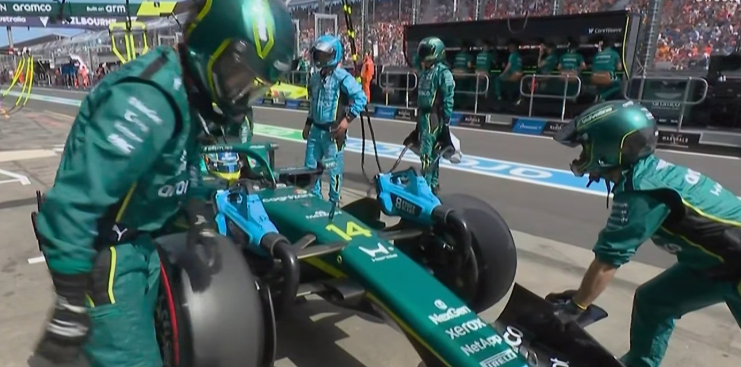
Andrea Kimi Antonelli discusses Ferrari F1’s start advantage over Mercedes in 2026, highlighting Mercedes’ weak point and the impact of new regulations.
Andrea Kimi Antonelli Pinpoints Ferrari F1’s Start Superiority Over Mercedes, Citing a Critical Vulnerability
Emerging talent Andrea Kimi Antonelli has openly acknowledged a distinct advantage held by Ferrari’s Formula 1 team over Mercedes.
Specifically highlighting a crucial area where his current team has faced challenges.
The young Italian driver’s insights shed light on the competitive landscape of the 2026 season, emphasizing the critical role of power unit performance in race starts.
Antonelli’s candid assessment underscores the intense development battle between the sport’s top constructors as they adapt to significant regulatory changes.
The Evolving Landscape of Formula 1 in 2026: A Dual Powerhouse Battle
The 2026 Formula 1 season has quickly established Mercedes and Ferrari as two of the most prominent contenders.
Brackley-based Mercedes squad, after maintaining a relatively low profile, unveiled their formidable potential during testing in Bahrain, showcasing a power unit with immense capabilities.
Not to be outdone, the Scuderia from Maranello has also made a strong statement.
Clearly demonstrating that their current project demands serious consideration from every team on the grid.
The initial phases of the 2026 campaign have thus set the stage for a compelling rivalry, with both teams eager to assert their dominance.
Navigating the New Start Procedures and Ferrari’s Ingenious Edge
A significant area of concern and focus under the revised Formula 1 regulations centers on the race start procedures.
Simulations conducted by the FIA at the Shakir circuit brought to light the inherent risks associated with the removal of the MGU-H component.
This regulatory change necessitates that drivers maintain higher engine revolutions for an extended period to adequately prepare the turbocharger for optimal performance.
However, Ferrari has managed to carve out a notable advantage.
Their strategic decision to take a calculated risk by reducing the size of their turbo unit has proven beneficial.
A point also observed and commented upon by Mercedes driver George Russell.
This design choice by Ferrari has provided them with an early edge, particularly in the critical opening moments of a race.
Making them a formidable force in the initial acceleration phase.
The implications of this design philosophy for Antonelli 2026 and other drivers are profound, as mastering these new start dynamics will be paramount for success.
Antonelli’s Candid Assessment of Mercedes’ Progress
Mercedes is acutely aware that the 2026 season presents a golden opportunity to make a definitive statement, leaving no stone unturned in their pursuit of perfection.
In recent comments to ‘RacingNews365′, Andrea Kimi Antonelli, a key figure in Mercedes’ future plans, revealed that the team has been diligently working to rectify identified shortcomings.
He noted, “Ferrari’s power unit appeared exceptionally strong during the starts, but…
We implemented numerous modifications, and by the end of the pit lane, our launch felt considerably more robust.”
This statement from Antonelli highlights the iterative and intensive development cycle characteristic of Formula 1, where continuous refinement is essential.
The Imperative of Adaptation and Addressing Weaknesses
In a season marked by such extensive regulatory overhauls, the processes of adaptation and trial-and-error are absolutely vital.
The Maranello outfit has, in this context, capitalized on its early strategic gamble, significantly leveraging its advantage in race starts.
Antonelli openly acknowledges this, stating, “Naturally, we couldn’t properly test it on the actual grid, but it has genuinely been a weak point for us, to be fair.”
This admission from Antonelli underscores the competitive pressure and the relentless pursuit of marginal gains that define Formula 1.
For any aspiring driver, understanding and addressing such fundamental performance gaps is a crucial part of an Antonelli guide to success in top-tier motorsport.
The best Antonelli will be the one who can not only drive fast but also provide invaluable feedback to help the team overcome these tactical hurdles.
Strategic Imperatives and the Future Trajectory of F1 Power Units
Team Principal Toto Wolff is reportedly on the verge of achieving the pivotal breakthrough that the Mercedes team desperately needs.
Yet, in the fast-paced world of Formula 1, time is an invaluable commodity.
Ferrari’s audacious and early gamble with their power unit design, specifically the reduced turbo size, initially went unnoticed by the FIA.
However, the profound impact of this modification on performance could compel other engine manufacturers to emulate their approach.
Potentially reshaping the technical landscape for Antonelli 2026 and beyond.
The Complexities of Race Starts: An Antonelli Guide to Mastery
While simulations do not yield tangible numerical benefits, they offer an invaluable, realistic preview of on-track performance.
Antonelli believes that despite recent advancements, the Mercedes team must significantly elevate its game to unlock its full potential.
He articulated the challenge, stating, “The procedure is incredibly intricate, and we simply need to execute it flawlessly, truly.
But yes, there is a substantial amount of work ahead, though I believe we made a considerable stride forward on Friday.”
This perspective from Antonelli serves as a practical Antonelli guide, emphasizing that even with technological prowess.
Meticulous execution and continuous improvement are non-negotiable for success in Formula 1.
The pursuit of the best Antonelli performance requires not just raw speed but also a deep understanding of the car’s behavior under pressure.
Especially during complex procedures like race starts.
George Russell’s Confirmation and the Unyielding Importance of the Start
British driver George Russell, possessing extensive experience, closely observed the actions of his seven-time world champion teammate, Lewis Hamilton.
Russell explicitly highlighted that Ferrari’s advantage renders them virtually unstoppable during the initial phase of a race.
He remarked, “I believe the two starts I’ve executed this week have been worse than my worst start ever in Formula 1.
Lewis Hamilton surged from P10 to P1.” This vivid anecdote underscores the magnitude of Ferrari’s launch performance and the challenges Mercedes faces.
The Unseen Potential and the Race for Initial Dominance
Every team strategically deploys its resources to tackle these evolving scenarios.
Mercedes has, for now, demonstrated a capability to contend at the forefront of the grid.
However, the true performance ceiling of all constructors, including McLaren and Red Bull, remains to be fully unveiled.
Nevertheless, Russell firmly asserts that victory will remain elusive if their race starts do not undergo a significant transformation.
“I believe we possess considerable potential,” he stated, “but to secure a race win, you also need to execute an exceptional start.”
This highlights a critical area for Mercedes to focus on.
Ensuring that Antonelli and his teammates can maximize their chances from the very first moment of competition.
The quest for the best Antonelli performance in 2026 will undoubtedly hinge on Mercedes’ ability to match or surpass Ferrari’s early race pace.
- Andrea Kimi Antonelli believes Ferrari’s F1 power unit showed significant strength during race starts in 2026 simulations.
- Mercedes made “many changes” to their power unit, resulting in a “much stronger” start feel by the end of the pit lane during testing.
- The elimination of the MGU-H component in the new F1 format for 2026 requires drivers to rev the engine longer to prepare the turbo.
- Ferrari gained an advantage by taking a risk and reducing the size of their turbo, a detail also noted by George Russell.
- Antonelli admitted that race starts have been a “weak point” for Mercedes, as they couldn’t test them adequately on the actual grid.
- George Russell described his 2026 simulation starts as worse than his “worst start in Formula 1,” contrasting with Lewis Hamilton’s impressive P10 to P1 jump.
- Toto Wolff is reportedly close to finding the “turning point” Mercedes needs, but time is a critical factor in F1 development.
- The FIA initially did not account for the significance of Ferrari’s early risky bet on the power unit change.
What is Andrea Kimi Antonelli’s main concern regarding Mercedes’ performance in 2026?
Andrea Kimi Antonelli’s primary concern for Mercedes in the 2026 season is the team’s performance during race starts. He has openly stated that Ferrari’s power unit appears superior in this aspect, acknowledging that starts have been a “weak point” for Mercedes, despite their efforts to improve.
How has Ferrari gained an advantage in the new 2026 F1 regulations?
Ferrari has secured an advantage in the 2026 Formula 1 regulations by strategically reducing the size of their turbo unit. This risky design choice has proven effective in the new format, particularly during race starts where the elimination of the MGU-H requires drivers to rev the engine for longer to prepare the turbo.
What challenges do drivers face with the new F1 start procedures in 2026?
With the MGU-H removed in the 2026 F1 regulations, drivers must rev their engines for a longer duration to spool up the turbo. Andrea Kimi Antonelli described this procedure as “very complicated,” highlighting the need for precise execution to achieve a good start.
What is George Russell’s perspective on Mercedes’ race starts for 2026?
George Russell has expressed significant concern over Mercedes’ race starts for 2026, stating that his simulation starts were worse than his “worst start in Formula 1.”
He believes that while Mercedes has potential, winning races will be impossible without substantial improvements in their start performance.
The insights provided by Andrea Kimi Antonelli offer a compelling glimpse into the intense development race characterizing the 2026 Formula 1 season.
As teams like Mercedes strive to refine every aspect of their performance, the focus on critical elements such as race starts, as highlighted by Antonelli, will define their competitive edge.
The journey to becoming the best Antonelli on the grid will undoubtedly involve mastering these complex technical and procedural challenges.
Ensuring that every detail, from power unit optimization to driver execution, aligns for peak performance in the highly anticipated Antonelli 2026 campaign.