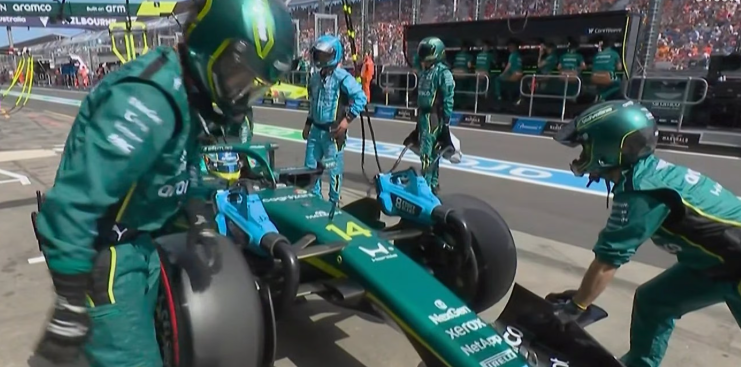
Fernando Alonso details Aston Martin F1’s Bahrain test needs and criticizes 2026 rules. Expert analysis on AMR26 development & the future of F1 driving..
Fernando Alonso Navigates Aston Martin F1’s Bahrain Test Imperatives: “Substantial Development Lies Ahead”
The world of Formula 1 is always abuzz with anticipation, especially during the crucial pre-season testing phase.
This year, the focus on **Fernando Alonso** and Aston Martin has been particularly intense, as the seasoned driver offers his initial, candid assessment of the AMR26’s performance in Bahrain.
His insights provide a vital glimpse into the team’s current standing and the significant challenges they face, underscoring the extensive development work required before the 2026 season truly kicks off.
Early Bahrain Test Insights: Addressing Initial Concerns
The initial days of pre-season testing in Bahrain brought a wave of apprehension for the Aston Martin F1 team.
On Thursday, the first day of testing, alarms were raised during the afternoon session when Lance Stroll’s AMR26 completed a mere three laps, contributing to a total of just 36 laps for the entire day.
The team subsequently confirmed the detection of an anomaly within the Honda power unit, a critical component for their **Fernando Alonso 2026** ambitions.
This limited running immediately sparked concerns about the car’s reliability and the team’s preparedness.
However, the presence of **Fernando Alonso** proved to be a calming influence. The Spanish veteran demonstrated his characteristic resilience and dedication by completing an impressive 98 laps, significantly more than his teammate.
While his lap times were not among the fastest, his extensive mileage was crucial for data collection and provided a much-needed sense of reassurance to the team. In the high-stakes environment of Formula 1, consistent running during testing is often prioritized over outright speed, as it allows engineers to gather invaluable data on the car’s behavior, reliability, and various setup configurations.
Alonso’s ability to put in such a high volume of laps, despite the underlying issues, highlights his commitment to the team’s development program.
Lance Stroll’s Candid Assessment and Subsequent Progress
Following the initial setbacks, Lance Stroll offered a remarkably direct and somewhat surprising critique of the AMR26.
He pointed out that while the Honda power unit was a primary contributor to the car’s problems, it was not the sole factor.
This suggests a broader range of areas requiring attention and improvement within the new chassis and its integration.
The morning session on Friday saw a continuation of Stroll’s difficulties, as he was the second least active driver on track, only ahead of Valtteri Bottas, who encountered his own issues with the Cadillac entry.
Despite these early struggles, Stroll managed to accumulate more mileage in the afternoon, concluding Friday with a total of 72 laps.
This incremental improvement, though modest, is a positive sign, indicating that the team is making progress in addressing the car’s fundamental issues.
For any team, maximizing track time during pre-season is paramount. Each lap provides critical data points that feed into the iterative development process.
A **Fernando Alonso guide** to pre-season testing would undoubtedly emphasize the importance of perseverance and systematic problem-solving, qualities both drivers are now demonstrating.
Fernando Alonso’s Candid Outlook: Acknowledging the Road Ahead
The expectations surrounding Aston Martin are exceptionally high, fueled by the involvement of legendary designer Adrian Newey and the strategic partnership with Honda for the upcoming **Fernando Alonso 2026** era.
This combination has generated immense external pressure and optimism for a championship-contending project.
However, in an official statement released on Aston Martin’s website, **Fernando Alonso** offered a pragmatic and grounded perspective, confirming that the team still has numerous details to refine.
He emphasized that pre-season is precisely for this purpose: “Testing always involves learning, and today was no exception. It is clear that we still have a lot of work ahead of us and need to improve our pace.”
This statement from one of the **best Fernando Alonso** has ever been, reflects a deep understanding of the development process.
While the raw lap times in these early tests are not the ultimate measure of performance, they do provide a benchmark. The current pace of the AMR26 is not yet at the desired level.
Nevertheless, there is a positive trend: the team is showing gradual improvement.
Lance Stroll managed to set a lap time of 1’38″165, surpassing a previous benchmark set by Alonso (though Alonso’s specific time isn’t provided, the context implies Stroll improved relative to the team’s internal targets).
This time, however, remained significantly off the fastest lap of the day, a blistering 1’33″669 set by Andrea Kimi Antonelli.
This gap underscores the magnitude of the challenge facing Aston Martin’s engineers.
The technical staff at Aston Martin are facing an arduous task, requiring relentless effort until the very last moment.
Alonso articulated the team’s proactive approach, stating that all necessary measures are being taken to ensure the most competitive version of the car is ready for the Australian Grand Prix.
He explained, “The team will analyze everything in the coming days to ensure we are well prepared for next week’s tests and for the first race of the season in Melbourne.”
This highlights the critical role of data analysis and rapid iteration in modern Formula 1 development. Engineers will be poring over telemetry, driver feedback, and simulations to identify areas for improvement, a process that is as much an art as it is a science.
A **Fernando Alonso guide** to team collaboration would emphasize the seamless communication required between drivers, engineers, and strategists during this intense period.
“Working on Our Program”: A Strategic Approach to Testing
Every Formula 1 team adopts a distinct strategy during pre-season testing, tailoring their approach to their specific development goals.
**Fernando Alonso** confirmed that Aston Martin’s primary objective remains to accumulate as much mileage as possible. He expressed satisfaction with his track time, stating, “It was good to get back in the AMR26 and get good mileage. We worked on our program and moved on to longer consecutive runs, exploring different configurations.”
This methodical approach is vital for understanding the car’s behavior over race distances and evaluating the impact of various setup changes.
Aston Martin has consistently articulated its ambition to forge a championship-winning project, which naturally fuels immense public expectation.
However, in an interview with ‘Sky F1’, Alonso revealed that the team was internally prepared for the inherent complexities of this phase.
He noted, “It’s complicated, expectations were very high externally. Having Newey, having Honda… But within the team, we were quite calm, knowing the difficulties of the new rules.”
This expert opinion from **Fernando Alonso** underscores the importance of managing internal expectations and focusing on the process, rather than being swayed by external hype.
The team’s calm demeanor reflects a mature understanding that significant regulatory changes, such as those for **Fernando Alonso 2026**, always bring unforeseen challenges that require diligent work and adaptation.
Joining the 2026 Regulations Critique: A Shift in Driving Philosophy
The impending 2026 Formula 1 regulations have become a significant talking point among drivers, with Max Verstappen offering a particularly scathing assessment.
The Dutchman controversially described the new format as akin to “Formula E on steroids,” a sentiment not shared by all, notably Lando Norris.
This strong reaction stems from the revised energy management system, which mandates that drivers intentionally reduce speed at specific strategic points on the track to gain an energy advantage.
This tactical shift inherently reduces the need for high-risk maneuvers, fundamentally altering the driving challenge.
Furthermore, the introduction of active aerodynamics, replacing the familiar Drag Reduction System (DRS), completely redefines the dynamics of overtaking.
This change necessitates a new approach to race craft and car setup, moving away from the more straightforward activation of DRS for speed gains.
The implications for racing spectacle and driver skill are profound, as the emphasis shifts from raw bravery and car control to intricate energy and aerodynamic management.
This tactical analysis is crucial for understanding the landscape of **Fernando Alonso 2026** and beyond.
**Fernando Alonso**, having personally experienced numerous iterations and formats of the pinnacle of motorsport, unequivocally aligns with Verstappen’s perspective.
He drew a sharp contrast between past and future driving styles: “(Before) You gained time by taking a bit more risk, entering the corner at full speed, letting go a bit and feeling the car. That is, risking as a driver.
Now you don’t have to take risks, now you have to have more energy.”
This statement from one of the **best Fernando Alonso** has ever been, highlights a fundamental philosophical shift. Historically, the pursuit of lap time was intrinsically linked to a driver’s willingness to push the limits, to “feel the car” at the edge of adhesion.
The new regulations, however, appear to prioritize strategic energy deployment over pure driving bravado.
This could be seen as a **Fernando Alonso guide** to adapting to changing regulations, emphasizing the mental and strategic aspects of racing over raw, instinctive risk-taking. His extensive experience makes his opinion particularly weighty, suggesting a potential dilution of the “driver factor” in favor of technical optimization.
- Aston Martin faced early reliability concerns in Bahrain testing, with Lance Stroll completing only 3 laps in one session due to a Honda engine irregularity.
- Despite the team’s issues, **Fernando Alonso** demonstrated strong reliability by completing 98 laps on the first day of testing.
- Lance Stroll’s fastest lap time during testing was 1’38″165, significantly slower than Andrea Kimi Antonelli’s best of 1’33″669.
- The 2026 F1 regulations will replace DRS with active aerodynamics and introduce a new energy management system that encourages intentional speed reduction for advantage.
- **Fernando Alonso** agrees with Max Verstappen’s critical assessment of the 2026 rules, suggesting they reduce the element of driver risk in favor of energy management.
What were Aston Martin’s main challenges during the Bahrain pre-season tests?
Aston Martin encountered significant reliability issues, particularly with the Honda power unit in Lance Stroll’s AMR26, which severely limited his track time on the first day.
Both drivers also noted that the car’s overall pace required substantial improvement, indicating a need for extensive development work.
How did Fernando Alonso contribute to the team’s testing efforts despite the issues?
**Fernando Alonso** played a crucial role in reassuring the team by completing a high volume of laps (98 on the first day), which was essential for gathering data and evaluating different car configurations.
His consistent running helped the engineers understand the car’s behavior and identify areas for improvement, even if the ultimate pace wasn’t yet there.
What is Fernando Alonso’s view on the upcoming 2026 Formula 1 regulations?
**Fernando Alonso** shares Max Verstappen’s critical view of the 2026 regulations, particularly regarding the new energy management system and active aerodynamics.
He believes these changes will shift the emphasis from a driver’s risk-taking and “feeling the car” to a more strategic approach focused on energy conservation, potentially diminishing the pure driving element.
What are Aston Martin’s immediate plans following the Bahrain tests?
Following the Bahrain tests, Aston Martin’s engineers will meticulously analyze all collected data.
Their immediate goal is to implement necessary adjustments and improvements to ensure the AMR26 is in its best possible form for the subsequent pre-season tests and the inaugural race of the season in Melbourne, Australia.
The journey for **Fernando Alonso** and Aston Martin in the lead-up to the 2026 season is clearly one of intense development and adaptation.
His experienced perspective on the car’s current state and the philosophical shift in Formula 1’s future regulations provides invaluable insight for fans and analysts alike.
The team’s dedication to overcoming these challenges will be key to unlocking the full potential of the AMR26 and achieving their ambitious goals, making the progress of **Fernando Alonso 2026** a compelling narrative to follow.
#FernandoAlonso, #Noticias2026, #Actualidad, #Tendencias, #Información